
Flowers
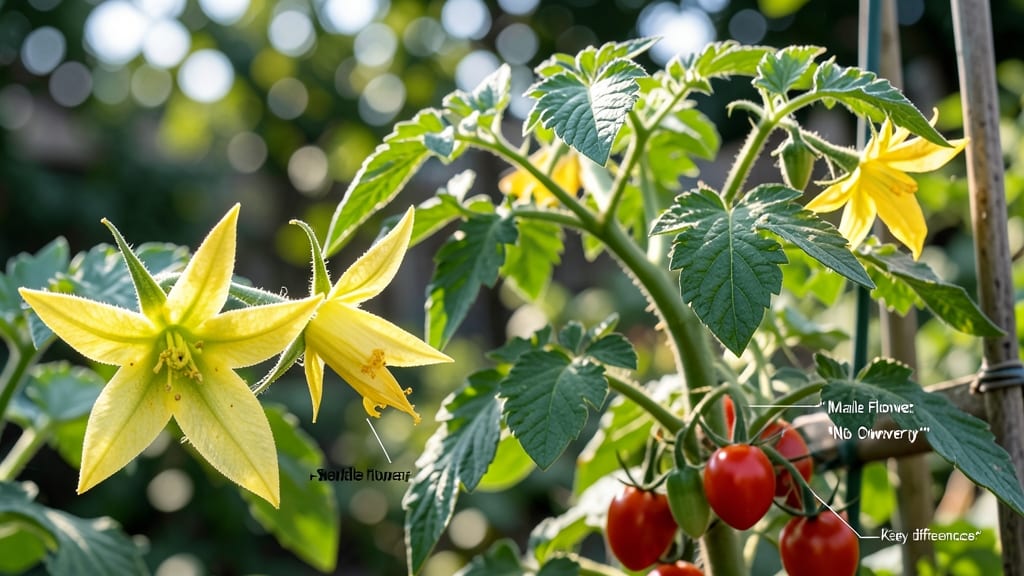
Identifying male and female tomato flowers is the secret to heavier harvests—those tiny differences between the two determine how many tomatoes you’ll actually eat. 🌱 I spent years pruning blindly until I learned the simple visual cues that tell them apart: male flowers have no fruit stem at the base, while female flowers already sport a tiny tomato (or "fruit set") behind the blossom.
This isn’t just trivia—it’s the key to directing your plant’s energy where you want it.
The easiest way to spot them is to look at the flower’s base: male flowers sit directly on the stem with no bumps, while female flowers have a little swelling where the future tomato will grow.
Early in the season, your plants might produce mostly males—they’re the pollen producers—but once females appear, that’s when the real action starts. I’ve seen plants with 30% more fruit after focusing on preserving female flowers and their supporting branches.
Here’s the game-changer: female flowers often appear in clusters, while males tend to grow singly. When you see that first little tomato hiding behind a blossom, you’ve found a female.
Prune strategically—keep the female-laden branches and trim back excessive males (unless you’re saving seeds). Your plants will thank you with bigger, earlier harvests all season long.
This works for all tomato varieties—whether you’re growing beefsteaks, cherry tomatoes, or heirlooms. The only exception? Some indeterminate varieties produce more males early on, but the same rules apply.
Once you start noticing these differences, you’ll see your garden’s potential in a whole new light—and your neighbors will be asking for your secrets.
📚 In This Guide
- What you need
- Instructions
- Tips and common mistakes
- Wrapping up and next steps
What you need
- ● Healthy tomato plants (indeterminate or determinate varieties work best—think cherry, beefsteak, or Roma!).
- ○ Magnifying glass or loupe (3x–10x magnification; optional but helpful for squinty-eyed gardeners!).
- ● Sharp scissors or pruners (sterilized with rubbing alcohol to avoid disease; small, clean cuts only!).
- ● Notebook & pen (to track flower types and plant progress—trust me, it’s a game-changer).
- ● Sunlight & patience (tomatoes love 6–8 hours of direct sun daily; flowers open best in the morning!).
- ● Garden journal app (like Gardenate or PlantNet for flower ID backups).
- ● Gloves (to keep hands clean while handling prickly plants).
- ● Camera with macro mode (for up-close flower pics—because science!).
- ● Pruning shears with bypass blades (gentler on stems than anvil pruners).
- ● Fertilizer (balanced 10-10-10 or tomato-specific) (to encourage more female flowers if needed).
How to identify male and female tomato flowers: tiny but critical differences that boost fruit
Here's how to spot the difference in minutes—no microscope required.
🌱 Step 1: Understand the Basics of Tomato Flower Structure
Tomato flowers have two key parts: the petals (the colorful outer bits) and the reproductive center. The male parts are the stamens (the thin, pollen-producing structures), while the female part is the pistil (the swollen base where fruit forms). Female flowers have both stamens and a tiny ovary at the base—this is your first clue.
Male flowers are simpler: they have stamens but no ovary. They look like tiny starbursts with no swelling at the base. Female flowers have that extra bump where fruit will develop. Think of it like a tiny egg-shaped swelling under the petals—this is where tomatoes grow!
🌿 Step 2: Locate the Swollen Ovary (The Female Giveaway)
Examine the center of the flower. If you see a small, rounded bump at the base (where the petals meet the stem), that's the ovary—the unmistakable sign of a female flower. It's usually greenish-yellow and slightly larger than the stamens. This bump is where the fruit will form if pollinated.
I like to gently pinch the flower between my fingers to feel the difference. Male flowers feel flat and smooth at the base, while female flowers have that little bump. This tactile check is especially helpful if flowers are small or the light isn't ideal.
☀️ Step 3: Count the Stamens (Male Flowers Have More)
Male tomato flowers typically have 5-6 stamens (the thin, thread-like structures with yellow pollen at the tips). Female flowers usually have 3-4 stamens because their energy goes into developing the ovary instead. Count them carefully—this is your backup method when the ovary isn't obvious.
Here's the thing—male flowers often appear first, especially in cooler weather. But female flowers are what you want for fruit production. If your plant is mostly producing male flowers, it might need warmer temperatures or more consistent sunlight.
⏰ Step 4: Observe Flower Position and Timing
Female flowers often appear in the leaf axils (the angle between a leaf and the stem), while male flowers tend to grow at the tips of branches. This positioning difference is another quick way to spot them before they even open. Watch for tiny buds forming in these spots—female buds will have that telltale swelling.
Timing matters too. Early in the season, plants focus on growing foliage and may produce mostly male flowers. As temperatures warm (above 65°F), female flowers become more common. If your plant is still mostly male after 4-6 weeks, it might need a little help—like a gentle shake to encourage pollination or a move to a sunnier spot.
✂️ Step 5: Use the "Pinch Test" for Confirmation
If you're still unsure, gently pinch the flower. Male flowers will feel hollow at the base, while female flowers have that firm, rounded ovary. This works best with fully opened flowers—before that, the ovary might not be fully developed yet. I do this when I'm training my plants to focus energy on fruit-bearing flowers.
Real talk: you don't need to identify every single flower. Focus on the ones that look promising (the ones with that little bump) and let the rest go. Your goal is to encourage more female flowers, not stress over perfect identification every time. The more you practice, the faster you'll spot the difference.
Tips & tricks for spotting tomato flower differences
These quick tricks will help you become a tomato flower detective in no time—even if you're not a botanist!
Lighting Matters: Natural daylight is your best friend when examining flowers. The greenish-yellow ovary of female flowers is easier to spot in bright light, especially near midday when shadows are minimal. If you're indoors, position your plant near a south-facing window or use a bright LED grow light. I've found that cloudy days make it harder to see the subtle differences—save your close inspections for sunny mornings.
The Magnification Hack: Grab a pair of reading glasses or a small magnifying glass (3x magnification works great) to examine the flower centers. This helps you see the tiny stamens clearly and spot the ovary bump without straining your eyes. I keep a cheap magnifier on my gardening belt—it's saved me from squinting and missing female flowers. For even better visibility, try using a phone with a macro camera feature to zoom in on tricky flowers.
Seasonal Timing Tip: Remember that temperature threshold of 65°F from Step 4? That's not just a number—it's when your plant starts shifting focus from foliage to fruit production. In cooler spring weather, you'll see more male flowers, but once temps consistently stay above 65°F, female flowers should become more common. If you're still seeing mostly male flowers after 6 weeks, try moving your plant to a warmer spot or using a small space heater (set to low) near it for a few hours each day.
Pollen Transfer Practice: Once you've identified your female flowers, give them a little help! Use a small paintbrush or cotton swab to transfer pollen from male flowers to female ones. Focus on the center of female flowers where the ovary is visible—this ensures proper pollination. I do this in the morning when flowers are freshest, and it dramatically increases fruit set. Just be gentle—you don't want to damage those delicate petals.
Pro Tips for Identify Male And Female Tomato Flowers
- These quick tricks will help you become a tomato flower detective in no time—even if you're not a botanist!
- Lighting Matters: Natural daylight is your best friend when examining flowers.
- The Magnification Hack: Grab a pair of reading glasses or a small magnifying glass (3x magnification works great) to examine the flower centers.
Frequently asked questions
Got questions about identifying male and female tomato flowers? You’re not alone! Here are some of the most common queries—plus quick, actionable answers to help you grow like a pro.
Why does it matter if I know the difference between male and female tomato flowers?
Female flowers (with tiny tomatoes at the base) are the ones that actually produce fruit. Male flowers (just petals and pollen) help pollinate but won’t bear tomatoes. Pruning excess male flowers can redirect energy to fruit production, giving you a bigger, more abundant harvest.
When is the best time to identify and prune male vs. female flowers?
Start checking flowers once they open—usually 4–6 weeks after transplanting seedlings. Morning is ideal because flowers are fully open and easier to inspect. Prune male flowers early in the season (first 2–3 weeks) to boost fruit set, but save a few later for pollination if your garden is isolated.
What if my tomato plant has mostly male flowers but no fruit?
Don’t panic! This is common in determinate varieties or during hot weather. Try these fixes:
- Hand-pollinate: Gently shake plants or use a paintbrush to transfer pollen.
- Adjust temps: Move plants to partial shade if temps exceed 90°F (32°C).
- Fertilize: Switch to a low-nitrogen, high-phosphorus fertilizer to encourage flowering.
Can I eat male tomato flowers? Are they edible?
Yes! Male tomato flowers are 100% edible and often used in cooking for their mild, slightly sweet flavor. Toss them into salads, garnish soups, or infuse oils for a gourmet touch. Just avoid flowers sprayed with pesticides—opt for organic plants if possible.
What if my plant keeps producing flowers but no tomatoes? Am I doing something wrong?
This usually happens due to stress or imbalance. Check these:
Issue
Solution
Too much nitrogen
Switch to a balanced 5-10-10 or phosphorus-heavy fertilizer.
Inconsistent watering
Water deeply 1–2x/week (adjust for climate) and keep soil moist but not soggy.
Poor pollination
Use a fan on low for 10 mins/day or hand-pollinate with a cotton swab.
Extreme heat/cold
Provide shade cloth or row covers if temps are above 90°F or below 55°F.
Wrapping up and next steps
Now that you’ve mastered the art of spotting male and female tomato flowers, you’re well on your way to a bountiful harvest! 🌱 Remember, those tiny differences—like the tiny fruit at the base of female blooms or the slender stems of male flowers—hold the key to healthier plants and more tomatoes.
With practice, you’ll spot them in seconds!
Your next step? Put your knowledge to work! Start by pruning strategically, pollinating by hand if needed, and watching your plants thrive. Happy gardening—your future tomato feast awaits! 🍅✨