
Companion Plants
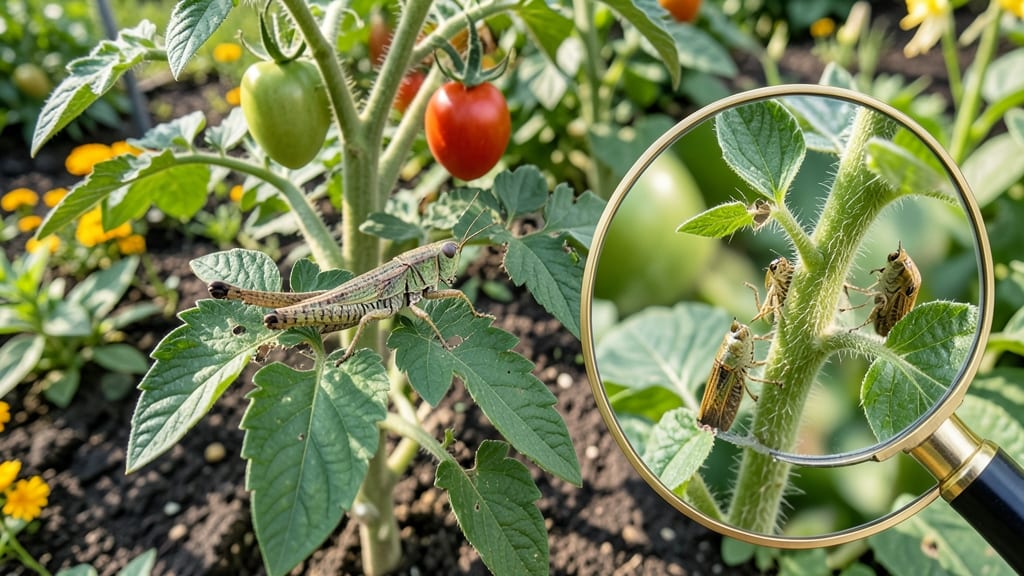
Grasshoppers do eat tomato plants, targeting leaves, stems, and sometimes fruit, leaving jagged holes and stunted growth. They’re particularly destructive during warm, dry weather when populations surge.
Grasshoppers are notorious for their voracious appetites, and tomato plants are a prime target thanks to their tender foliage and sweet fruit. 🌱 These pests use their powerful chewing mouthparts to strip leaves down to their veins, creating a distinctive "skeletonized" appearance that weakens the plant's ability to photosynthesize.
What makes them especially problematic is their seasonal behavior—when temperatures rise above 80°F, grasshoppers become more active, often swarming and devouring entire tomato crops within days if left unchecked.
Identifying their damage early is key to saving your harvest. Look for irregular holes along leaf edges and chewed stems, which can cause plants to wilt or collapse. Even fruit isn't safe—grasshoppers will gnaw on unripe tomatoes, leaving behind ragged bite marks that make them unmarketable.
The good news? Their feeding patterns leave clear clues, helping gardeners act before the infestation spirals out of control.
💡 In This Article
- How Grasshoppers Damage Tomato Plants and Identify Their Feeding Patterns
- Natural and Chemical Grasshopper Control Methods for Tomato Gardens
How grasshoppers damage tomato plants and identify their feeding patterns
Grasshoppers attack tomato plants using their powerful mandibles—jaw-like mouthparts designed to crush and chew plant tissue. Unlike caterpillars that cut leaves cleanly, grasshoppers tear irregular holes along leaf edges, creating a signature "windowpane" effect. Their preferred targets are young, tender leaves and stems, where the nutrient content is highest.
A single grasshopper can consume up to 100 pounds of foliage per acre annually, and during outbreaks, they’ll strip entire plants bare in under 48 hours. 🔥
The damage isn’t just cosmetic—it triggers a cascade of stress responses in tomatoes. When leaves are skeletonized, the plant loses 30-50% of its photosynthetic capacity, leading to stunted growth and reduced fruit production.
Grasshoppers also target blossoms and green fruit, causing them to drop prematurely or develop misshapen, scarred surfaces. You’ll often find faecal pellets (small, dark droppings) near feeding sites, which further contaminate the plant and attract fungal infections.
Seasonal activity peaks when daytime temperatures exceed 80°F and nighttime lows stay above 65°F. This is when grasshoppers undergo their final molts and become most active feeders.
Look for swarms of 1-2 inch long insects with powerful hind legs—these are the nymphs that will soon become the most destructive adults. Their feeding patterns are most aggressive in late summer, when tomato plants are lush and vulnerable. 🌟
Identifying their damage early requires close inspection. Start by checking the undersides of leaves for fresh feeding marks, which appear as irregular, jagged notches rather than the smooth cuts made by slugs or beetles.
Grasshoppers also leave behind frass (chewed plant material) that resembles tiny black specks. If you spot these signs, act quickly—once a plant’s energy reserves are depleted, recovery becomes nearly impossible.
What makes grasshoppers particularly challenging is their mobility. Unlike aphids that stay put, these pests can jump 20 times their body length, making them difficult to trap or control once established.
Their rapid reproduction cycle (one generation every 6-8 weeks) means populations can explode overnight, turning a minor issue into a full-blown garden crisis. The key to prevention lies in monitoring plant health daily and intervening at the first sign of stress.
Consider this: a single egg pod can contain 20-50 eggs, and these nymphs will emerge as adults in 30-45 days. By the time you notice visible damage, the infestation may already be beyond basic control measures.
This is why gardeners in high-risk areas (like the Midwest and Great Plains) often combine physical barriers, natural predators, and cultural practices to stay ahead of outbreaks. 💫